

French Drain vs Surface Drain vs Catch Basin
French drains, surface drains, and catch basins solve water problems in different ways, and choosing the wrong one can leave a yard merely as wet as before. A French drain targets subsurface saturation, while a surface drain captures runoff where it shows up. Catch basins sit in low points and trap debris before sending water onward. The right choice depends on soil, slope, and where water actually collects—details that are often missed initially. If you want a quick overview of all the options we install, start here: Drainage Solutions.
Key Takeaways
- French drains intercept subsurface seepage in saturated soil, making them best for soggy areas and clay-heavy yards with groundwater issues.
- Surface drains capture visible runoff at ground level, preventing puddles in low spots and along flat areas after heavy rain.
- Catch basins collect water at a specific low point, trap debris in a sump, and send flow into a solid drain line.
- Choose based on water source: seepage favors French drains, sheet runoff favors surface drains, and funneling flow favors catch basins.
- All three require proper slope and a safe discharge point; poor grading or the absence of an outlet are the most common causes of failure. If your yard holds water in multiple areas, yard grading & resloping may be the missing piece.
French drains explained
A French drain is a gravel-filled trench with a perforated pipe that intercepts water in saturated soil and carries it to a safe discharge point.
It works best for soggy side yards, fence lines, and low areas where water seeps through clay soil after heavy rain and can be routed downhill.
It is the wrong fix when the problem is mostly surface runoff or roof downspouts without proper slope and an outlet, since many installs fail when the discharge location is ignored. If the water is coming from the roof, downspout drainage is usually the first move.
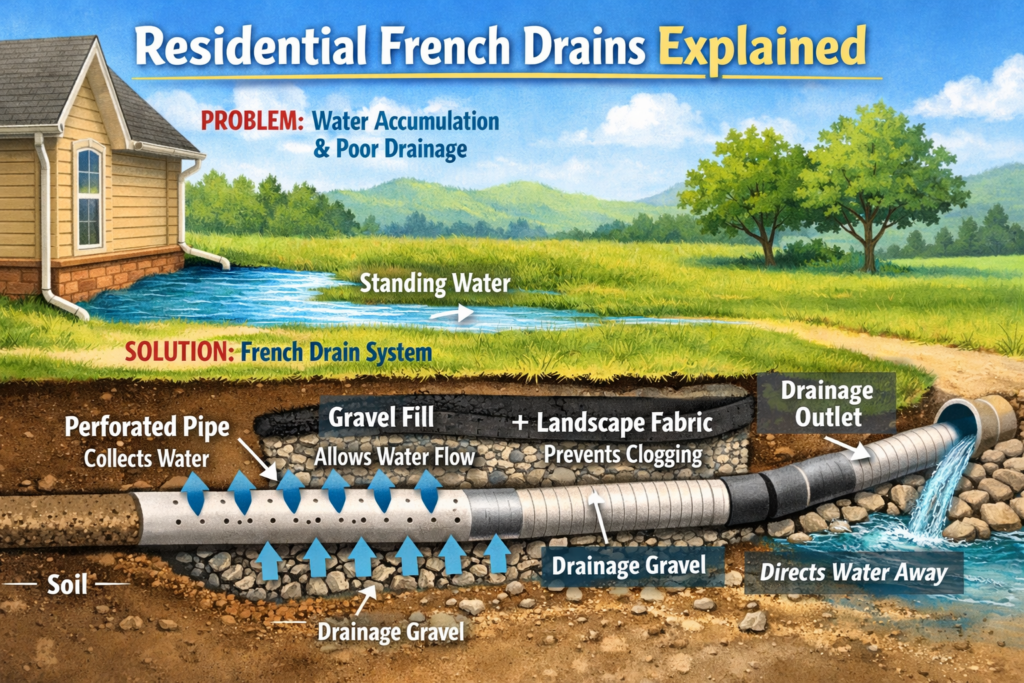
What a French drain is
Underground gravel-and-pipe trenches, commonly called French drains, are designed to collect and redirect excess water that saturates soil below the surface.
They use a perforated pipe set in washed gravel and wrapped with filter fabric to reduce clogging, then carry water to a safe discharge point away from homes and hardscape.
This approach helps homeowners by protecting foundations, easing soggy lawns, and reducing erosion after heavy rains.
Proper French drain installation accounts for depth, pipe placement, and outlet location. For details on how we build these systems, see our French Drains service page.
Many homeowners look to trusted local crews for drainage solutions to get the layout, materials, and discharge plan right the first time.
When a French drain works best
When water is rising from the soil rather than racing across the grass, a French drain tends to work best. It intercepts subsurface seepage and relieves soggy turf by providing a more direct path for water through gravel and a pipe to a safe discharge point.
This option is often the right drainage fix for low spots that stay spongy days after Helotes storms, especially in clay soil. It also helps along fence lines, side yards, and near foundations where moisture slowly accumulates.
To fix pooling water in the yard, success depends on a steady slope and a planned outlet. If your yard is too flat, pairing drainage with grading/resloping is often what makes the system actually work.
When a French drain is not the appropriate solution
French drains solve the “soggy-from-below” problem, but they get recommended too often for issues they can’t fix.
If water is running across the lawn after heavy San Antonio storms, pooling in a low spot, or spilling from downspouts, surface collection usually wins out over French drains. That’s when surface drains & catch basins tend to solve the problem faster.
In Helotes clay soil, a buried trench can clog, and without proper slope and a safe discharge point, it becomes a wet gravel ditch.
A simple site check should confirm the source, grade, and outlet before digging. If you want us to take a look, use our Contact Page or call (210) 625-6438.
Surface drains explained
A surface drain is a grated inlet set at ground level that captures runoff from the yard and sends it through a pipe to a safe discharge point.
It works best in low spots where water ponds after heavy rains, along patios or fence lines, and where clay soil prevents quick soaking—especially when the yard’s slope naturally directs water to one area.
Common mistakes include placing the inlet too high, using a pipe without enough slope, and discharging water where it can wash out soil or flow back toward the foundation. If you want examples of clean installs, browse the Gallery.

What a surface drain is
Surface drains, often installed as narrow grated channels or low-profile drain inlets at ground level, are designed to capture water that runs across the yard before it can form puddles, turn grass to mud, or wash out soil.
Water enters through a grate and is carried by a connected pipe to a safe discharge point, typically daylight or an approved outlet. Unlike subsurface systems, they manage visible runoff moving over the surface.
When planned well, surface drains are one of the most practical yard drainage solutions because they catch water exactly where you see it. Proper slope, inlet placement, and discharge location determine success and reduce foundation risk.
Best use cases for surface drains
In many Helotes and northwest San Antonio yards, the best use for this type of drain is to collect fast-moving runoff before it turns into puddles, mud, or erosion—especially during heavy rain on clay soil. Surface drains work best where water moves across turf or hardscape toward a safe outlet and where a catch basin would be oversized for shallow sheet flow.
| Location | Water source | Why it fits |
|---|---|---|
| Side yard | Sheet runoff | Stops muddy traffic |
| Patio edge | Splash/flow | Prevents pooling |
| Fence line | Yard runoff | Reduces erosion |
Common surface drain mistakes
Many surface drains fail for simple reasons: they’re placed where water doesn’t actually flow, set too high to intercept runoff, or tied into a line that has no reliable slope and discharge point.
Other common mistakes include undersized grates, shallow trenches that silt in, and outlets that dump water against a fence or foundation.
In Helotes’ clay soils and heavy storms, neglecting grading and cleanouts leads to recurring puddles. If your yard is flat or water is flowing the wrong way, start with yard grading/resloping, then add drains where water concentrates.
When runoff concentrates in one bowl-shaped low area, a properly placed catch basin can prevent overflow.
Catch basins explained
A catch basin is a grated inlet box that collects water from a low spot (or downspout area) and sends it into a solid drain line to discharge away from the yard and foundation.
It works best where water consistently ponds—such as in backyards with clay soil, near downspouts, or at the bottom of a slope along a fence line—when there is a clear discharge path.
Unlike a trench drain, which intercepts sheet flow along a straight run (like a patio or driveway edge), a catch basin targets a single collection point.

What does a catch basin do?
Capture and redirect runoff before it turns a low spot into a puddle—that is the job of a catch basin.
Set at grade, it collects surface water through a grate and drops it into a box where debris can settle. From there, a solid drain line carries water away to a safe discharge point, reducing standing water in the yard after heavy rain.
As it intercepts surface flow, it supports drainage in clay-heavy yards that shed water rather than soak it in.
Regular cleanout keeps the grate clear and the basin working as intended year-round.
Where catch basins work best
Low spots are the catch basin sweet spot—places where rainwater naturally funnels and stalls.
In Helotes and northwest San Antonio, clay soil and heavy rain can trap runoff, so a basin helps collect it and send it to a safe discharge point. This reduces mess, slip hazards, and erosion while keeping water away from foundations.
Yard drainage system costs stay more predictable when the basin is placed where water already converges (instead of guessing).
- Backyard depressions after storms
- Side-yard pinch points between homes
- Near downspouts that overflow
- Along fence lines with pooled runoff
- At patio or walkway low edges
Catch basin vs trench drain (quick difference)
Once a catch basin is installed where water naturally gathers, the next question is whether a trench drain would better address the problem.
A catch basin is a point inlet: it captures water in a low spot and directs it through a solid pipe to a safe discharge point. A trench drain is a linear inlet: it intercepts sheet flow along a driveway edge, patio, or garage door.
In Helotes, both catch basins and trench drains can fail if the slope and outlet are not properly planned.
San Antonio Landscaping Services can evaluate flow paths; call (210) 625-6438 or reach us here: contact us.
How to choose the right system
Choosing the right drainage system starts with identifying the water source and the yard’s slope, especially in Helotes and northwest San Antonio, where heavy rains and clay soil can leave yards holding water.
If water is coming from the roof, a downspout tie-in to a solid drain line or surface collection is often the best fit; if water is pooling in a low spot, a catch basin or surface drain typically captures it fastest.
If the yard slope is the real problem, grading and a planned discharge location usually matter more than adding another drain, since many fixes fail when water has nowhere to flow. (That’s exactly what our Yard Grading & Resloping service is built to address.)

If water is coming from the roof
When roof runoff is the main source of water, the best drainage fix is usually the one that captures downspout flow and moves it to a safe discharge point away from the foundation.
In Helotes and northwest San Antonio, heavy rains and clay soil make downspout tie-ins and solid pipe discharge especially helpful. Learn more about what we install on our Downspout Drainage page.
- Choose a solid downspout line to daylight or an approved outlet.
- Add a surface drain at splash zones near walkways.
- Use a catch basin where multiple downspouts meet.
- Avoid French drains for pure roof water unless overflow needs soak-in.
- Confirm slope and discharge; ignored outlets cause failures.
San Antonio Landscaping Services can evaluate options; call (210) 625-6438.
If water is pooling in a low area of your yard
Low spots that hold water after a storm point to yard runoff and grade issues more than roof runoff.
In those areas, a surface drain or catch basin usually helps most by collecting surface water and conveying it through a pipe to a safe discharge point. See how we typically build these systems here: Surface Drains & Catch Basins.
A catch basin fits best where water funnels into a single “bowl,” such as a backyard low spot or along a fence line.
A surface drain suits a longer soggy strip.
A French drain helps when water seeps through clay soil, not when it sits on top.
San Antonio Landscaping Services can evaluate discharge and slope. (210) 625-6438
If the yard slope is the real problem
Two drainage systems can be installed perfectly and still fail if the yard’s grade doesn’t move water toward a safe discharge point.
In Helotes and northwest San Antonio, clay soil and heavy rains often reveal a negative slope toward the house or flat areas that trap runoff. The first step may be grading or resloping, which can then allow the drains to function effectively.
- Water sits across a broad area, not one spot
- Runoff flows toward the foundation
- Swales/fence lines block discharge
- Downspouts dump onto flat turf
- Erosion shows concentrated flow paths
San Antonio Landscaping Services evaluates slope, soil, and outlet. Learn more about yard grading & resloping, or call (210) 625-6438.
Can you combine solutions?
Yes—many yards in Helotes and northwest San Antonio need a combination, such as a catch basin that feeds a solid pipe to a safe discharge point.
Roof runoff can be handled by tying downspouts into a line while also collecting surface water from low spots in the yard.
For the most reliable long-term results, grading to restore proper slope is often paired with drains to keep water from pooling around the home. Start here if you want the full system view: Drainage Solutions.

Catch basin + pipe discharge
Pairing a catch basin with a solid drainpipe and a proper discharge point is one of the most reliable ways to move water out of a persistent low spot. It collects surface runoff, then sends it to daylight or an approved outlet, helping protect lawns and foundations during Helotes-area downpours and clay-soil saturation.
For homeowners, it’s a tidy solution when slope and endpoint are planned.
- Set the basin at the lowest, soggiest point
- Use a solid pipe to prevent soil intrusion
- Maintain a continuous fall to the outlet
- Add cleanouts for long-term maintenance
- Keep discharge away from neighbors and slabs
Downspout tie-in and yard collection
When roof runoff and yard runoff are both contributing to soggy areas, combining a downspout tie-in with surface collection can be the most efficient way to control the water. A solid downspout line carries roof water away, while a nearby yard inlet captures puddling from clay-heavy soil after Helotes storms.
Success depends on maintaining pipe fall and choosing a safe discharge point—not burying outlets. If the roof runoff piece is the main issue, see “Downspout Drainage.”
| Component | Role |
|---|---|
| Downspout tie-in | Captures roof runoff |
| Yard inlet | Collects surface pooling |
| Solid pipe | Moves water reliably |
Grading + drains (best long-term combo)
Although a French drain, surface drain, or catch basin can move water away, combining basic yard grading with the right drain is often the most reliable long-term fix in Helotes and northwest San Antonio, where clay soil and heavy rain can overwhelm flat areas.
Grading guides sheet flow; drains handle concentrated runoff and protect foundations. This is why we often start with grading & resloping before adding collection points.
- Re-slope to shed water from the house
- Use surface drains for broad yard runoff
- Add catch basins at low spots or downspouts
- Tie basins to a solid pipe for a safe discharge
- Verify outlet slope and location
San Antonio Landscaping Services can evaluate your yard and recommend the most cost-effective solution. Book an evaluation here: Contact Us or call (210) 625-6438.
What should a drainage evaluation look for?
A proper drainage evaluation should first identify the water source (roof runoff, yard runoff, or both) and note where pooling begins.
It should then confirm the yard’s slope and flow direction to determine whether water can flow naturally or requires collection and piping.
Finally, it should verify a safe discharge location so any French drain, surface drain, or catch basin actually carries water away without creating a new problem. (This is the core of what we do on our Drainage Solutions page.)
Water source
Three questions guide a proper drainage evaluation: where the water is coming from (roof runoff, uphill yard runoff, irrigation leaks, or groundwater seepage), how it moves across the property (slope, soil absorption in clay-heavy areas, and any barriers like fences or hardscapes), and where it can safely discharge without creating a new problem.
In Helotes and northwest San Antonio, heavy rains and clay soil make source tracing crucial. An evaluation should check:
- Downspouts dumping near foundations
- Low spots fed by neighboring yards
- Sprinkler overspray or broken heads
- Persistent wet seams suggesting seepage
- Hardscape edges concentrate runoff
Slope and flow direction
Because drainage systems only work when water can move downhill, a professional evaluation focuses next on the yard’s slope and flow direction—where runoff naturally travels during a storm and where it becomes trapped.
The assessor notes high points, low spots, and flat clay areas common around Helotes, which retain water after heavy rains. They check whether roof runoff and yard runoff are moving toward the home, fence lines, or walkways.
Simple checks include watching water paths during rainfall, running a hose, and using a level to confirm positive grade. These observations guide whether grading or collection drains are needed.
Safe discharge location
Downhill is only half the equation; every drain also needs a safe place to let water out. A drainage evaluation should confirm that discharge won’t harm neighbors, foundations, or sidewalks and can handle Helotes’ heavy rains and clay soils.
It should check:
- daylight outlet to a stable, lower area
- tie-in to an approved curb or storm inlet (when allowed)
- distance from slab, fence lines, and property edges
- erosion control at the outlet (rock, splash block)
- cleanout access for future service
Many systems fail when discharge is blocked, uphill, or buried.
Frequently Asked Questions
How Long Does a Typical Drainage System Installation Take?
A typical drainage system installation takes one to three days, depending on yard size, soil, and discharge needs. San Antonio Landscaping Services evaluates slopes and outlets to prevent failures. Learn about our full process here: Drainage Solutions, or call (210) 625-6438.
What Permits or HOA Approvals Might Be Required in Helotes?
In Helotes, permits may be required for grading, curb cuts, sidewalk work, or tie-ins to storm drains; HOAs often require approval for landscaping/drainage plans. If you’re unsure, contact us here: Contact Us or call (210) 625-6438.
How Much Maintenance Do Drains and Basins Need Each Year?
Most drains and basins need 1–2 checkups yearly: clear debris from grates, flush lines, and confirm discharge flow after heavy rains. In clay soils, sediment builds faster. San Antonio Landscaping Services can inspect; call (210) 625-6438.
Will Installing Drains Damage Existing Irrigation Lines or Tree Roots?
Drains can disturb irrigation lines or tree roots if trenches intersect them, but careful location, shallow routing, and hand-digging near roots reduce the risk. San Antonio Landscaping Services marks utilities/irrigation first; call (210) 625-6438.
What Drainage Solution Works Best When Utilities Limit Digging Depth?
When utilities limit digging depth, shallow surface collection and rerouting—through yard grading and downspout drainage—often work best; deep trenching risks service disruption. San Antonio Landscaping Services can assess and plan safe discharge routes. Start here: Drainage Solutions.
Conclusion
Like channels etched into a terrain, French drains, surface drains, and catch basins each guide water toward order. French drains slip beneath the soil, catching hidden seepage before it turns lawns to sponge. Surface drains skim the ground, pulling sudden runoff away from patios and paths. Catch basins wait in low places, settling leaves and grit as water pools, then exits. The best choice depends on slope, soil, and flow—sometimes braided together. If you want us to recommend the cleanest fix for your yard, start with our Drainage Solutions page or reach out here: Contact Us. You can also see finished work in our Gallery.